
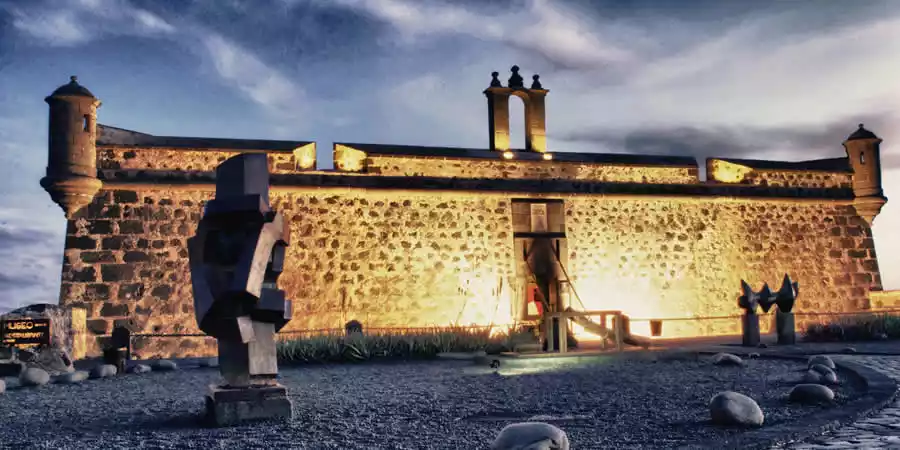
In each municipality of Lanzarote the historical past of the island appears, both in its pre-Hispanic representations, as in the constructions traced in its more than five centuries of European history, which respond to the most contrasting styles in the history of architecture: some of clear foreign inspiration and others with the unmistakable stamp ble contributed by several styles.
We dedicate this series to those works made by man on our island that stand out for their beauty, for their survival over the centuries or for being a clear example of the achievements of tenacity and effort.</ p>
The aboriginal population of the Island, although it took advantage of the caves, it lived fundamentally in the deep houses, typical of Lanzarote and in which the floor is excavated in the earth and so on. part of the house is below ground level, which reduces the effects of heat, cold or wind.
After the Conquest, the house in Lanzarote faces south to protect from the wind and sun and generally has an L-shaped floor plan and a patio, which is closed when more rooms are added. There are also other facilities such as stables, corrals, ovens or cisterns.
Notable elements are the chimneys, which show various forms resulting from Andalusian, Moorish and Portuguese influences.
The houses of the privileged classes had some of these characteristics, such as large patios, and added others such as a second floor, balconies...
In recent decades there has been an integration of traditional forms in new constructions, an example of which is various works by the artist from Lanzarote, César Manrique.
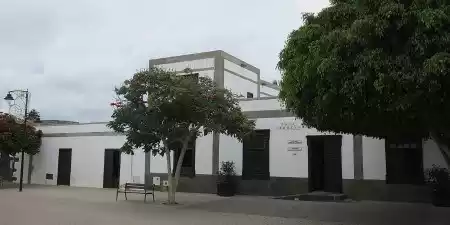
La Casa Sardeña, Built in the 17th century, is one of the few old and stately houses that are preserved in the municipality of San Bartolomé
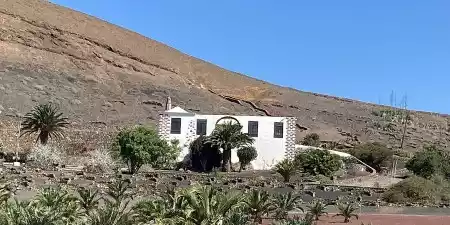
Don Francisco Tomás Guerra Clavijo, Major Guerra, had his house built on the slopes of the Cascajo hills. The year was 1764.

Located at the back of Palacio Spínola , was built in the 18th century and is a typical example of the Lanzarote urban manor house.

This is a stately farm building from the 18th century that currently it hosts temporary exhibitions.

Currently it has cultural functions (exhibitions, assembly hall, etc), social and administrative and is cataloged as Monument
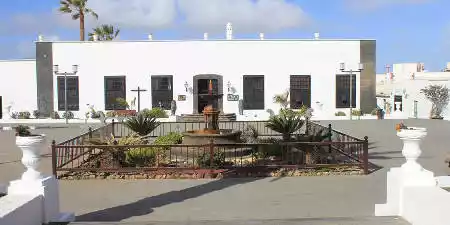
The Spínola Palace located in front of the Plaza de San Miguel, built by D. José Feo Peraza between 1730 and 1780. It was restored in 1974.

Old agricultural warehouse in Tiagua covered in an ethnographic center of Lanzarote culture and traditions. You can taste wine and artisanal cheese.

La Fundación César Manrique (FCM) is a private cultural institution whose objective is the preservation and dissemination of the work of César Manrique.
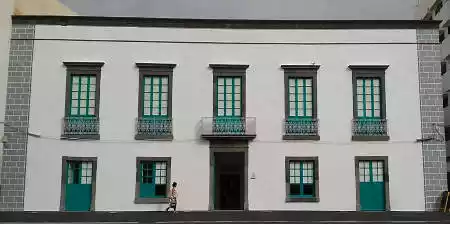
A good example of residential architecture in Lanzarote now houses 3 exhibition halls and an art gallery with more than 300 paintings.
The house is known as the Casa Cuartel de la Guardia Civil because the headquarters of this body was located there for many years.
Built in the s. XV, preserves the simplicity of the popular architecture of Lanzarote. Currently it serves to expose the characteristics of daily life on the island in the 18th century.

The visitor will be able to enjoy of a unique experience in a quiet natural environment such as the Haría Valley.
Don@#%s 16th century home Agustín de Herrera y Rojas, I Marqué s of Lanzarote, turned La Villa into the political and social center of the Canary Islands
Lanzarote has suffered various episodes warlike throughout its history. After the Norman Conquest, and as a result of its status as a possession of the Spanish Empire, the island received Portuguese, French and English attacks. Moriscos and Algerians would also attack due to proximity, the desire to capture slaves and as a response to the raids that the lords of Lanzarote made to the African coasts in search of slaves.
The lords of the Island, responsible for its protection, began the construction of the first defense structures, and the tower that the Normans built on the Rubicon (of which there are no remains today ) followed by the Castles of Santa Bárbara and San Gabriel, and later the Crown assumed the construction of the Castillo or Torre del Águila and San José.
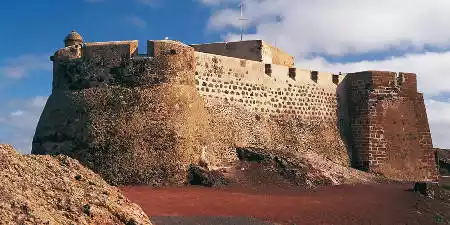
It is the oldest castle of those of the archipelago. Its current appearance dates from works that were completed in 1596.
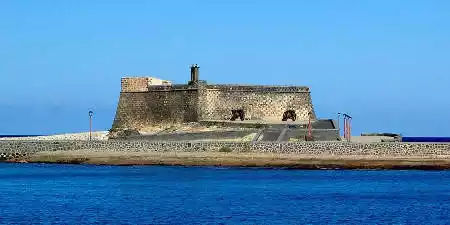
Originally it was a fortress of wood, but it was insufficient to fulfill the defensive tasks

This fortress was built between 1776 and 1779 during the reign of the Bourbon monarchy of Carlos III.
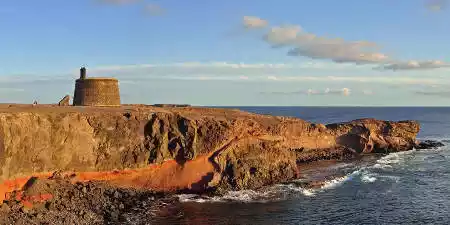
Built in a strategic place, from where you can see a large area of the sea.
Lanzarote was provided over time with different buildings intended to provide different types of services.
These constructions, like the rest of the island's architecture, expose in some cases the coexistence of various styles.
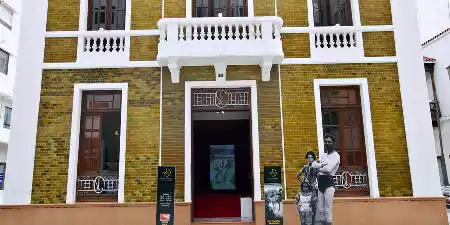
Disclosure area of the Cabildo de Lanzarote that organizes temporary exhibitions focused on the Knowledge and Memory of Lanzarote.
El Ayuntamiento de Haría It was inaugurated in 1921, being the first building on the Island built for administrative purposes.
The house of the Arroyo is an 18th-century building, declared a historic-artistic monument.
Este Fourth-order lighthouse with white light is located in the municipality of Yaiza, in Punta de Pechiguera, from where it takes its name.
The religious constructions after the Conquest are remarkable for several aspects. In the first place, it is striking that practically throughout the Island we find churches and hermitages, a sign of the importance of the Catholic Church, which even in a territory with such limited resources as that of Lanzarote was able to mobilize the necessary funds for the construction of the temples.
Most of the hermitages and churches were built at the initiative of notable people of the Island, who frequently endowed them with images, ornaments, farmland... No civil uses.
Another remarkable aspect is the artistic one, since as a result of the varied influences that the Island (Portuguese, Moorish...) and its relative isolation we find different styles coexisting in harmony, although in some cases they were already outdated in their places of origin. The overlapping of styles is also due in some cases to fires and, in Teguise, to the destruction resulting from the invasions that Teguise suffered. the Island.
Located in the town of Haría. It has been under the patronage of Saint John the Baptist since 1625, although it is older. Its ceiling is in the Mudejar style, and inside it houses a carving of the Virgin of the Assumption, the work of Luján Pérez, an outstanding sculptor from Gran Canaria from the 16th century. XVIII that made Works throughout the Archipelago.
Located in the town of Mala. It was worshiped in 1809 and houses a rich imagery inside.
Located in the town of Máguez. The most striking element of this hermitage is a beautiful altarpiece designed by the artist from Lanzarote, César Manrique.
Located on the cliff of Las Nieves. It is the reconstruction, on a larger site, of the one that already existed in the s. XVII.
The Virgen de las Nieves, patron saint of the Island, has been the object of strong devotion since her arrival on the Island in the 16th century. XV, being attributed the ability to bring rain. That was the reason why pilgrimages were made to her sanctuary, and that from the s. XVIII a descent was made to the Villa de Teguise, which acquired lustral character and that was celebrated until 1939. However, whenever there was a lack of rain, they went to the Virgin and made the Descent.
Currently, every August 5, the day of the Virgin, a pilgrimage is made to her sanctuary.
Located in the town of Los Valles. This hermitage was raised in the S. XVIII by the inhabitants of Santa Catalina, who fled to the north of the island after their town was buried with the Timanfaya eruptions.
With a Mudéjar roof, it was reformed, adopting its current Latin cross plan.
It houses several images and paintings from the s. XVIII.
Located in the town of Teseguite, it was built in the 17th century, sharing with other churches the Mudejar ceiling and a Canarian Baroque-style altarpiece. Its interior also houses images of San Leandro and the Virgin.
Located in the town of El Mojón, this church was built in the s. XVII, finding again the Mudéjar ceiling, in addition to several images of interest.
Located in the Plaza de San Miguel de Teguise. The church was built at the beginning of the XV century, and already in 1445 it was used for administrative acts.
Being located in Teguise, it suffered the effects of the invasions. In fact, his image of the Virgin of Guadalupe was seized during the 1569 invasion and decapitated in Morocco, later recovered. The church overcame All these adversities to achieve a great beauty reflected in the choir and stalls that it possessed.
It housed also to the Virgen del Carmen, of great devotion in Teguise, but her image was destroyed in a fire in 1909.
The various disasters that the church has suffered are responsible for its varied and attractive architecture, highlighting its tower, which rises above the average height of the Villa.
Inside it we find a plaster altarpiece, some thirty images, several silver objects and a dozen neo-Gothic altarpieces.
Located in the Plaza de la Veracruz in the town of Teguise. it was opened to worship in the s. XVII, housing a Portuguese carving of the Christ of Veracruz from that same century notable for its long hair, which reaches to the waist. The coffered ceiling is Mudéjar, and the altarpiece is Baroque in the Canary Islands.
Currently it is closed.
Located in the Plaza de la Constitución in the town of Teguise. Although it is not a religious building, it is. that it is a building of the Catholic Church, since it was built in the 1st half of the s. XVII as a storehouse for the tithes and firstfruits of the Church.
Located in Lomo de San Rafael - Majuelo. The hermitage, with a single nave, was built in the S. XVII. Its ceiling is Mudéjar, and it has a Canarian baroque-style altarpiece. Another notable element is the belfry, placed at the back of the temple.
Located in the town of Tao, this church built in the early s. XVII, it is already mentioned in 1627. Its altarpiece and imagery are of interest, and the ceiling belongs to the Mudéjar style.
Located in the town of Tiagua. It was founded in 1612, and although it has been renovated several times, it retains its single-nave structure. In front of its facade was built a a cistern for the use of the poorest.
Inside there is an interesting altarpiece and stone images, paintings and a silver lamp, all testimonies of the agricultural wealth of the town.
Located in the town of Soo. It was opened for worship in the s. XVIII, and has the particularity that it is in a town, Soo, created by the Moors captured in the 16th century during the African raids of Agustín de Herrera.
It has several images of wood inside.
Located in the town of Guatiza. Built in the s. From the 19th century, its stonework façade and its coffered ceiling are remarkable. It also has a painting of souls from the s. XIX and an image of Santa Margarita from the s. XVII.
Located in the town of Mozaga. This church, whose first mass was celebrated In 1785, it has a coffered ceiling, a baroque altarpiece and an image of the Virgen de la Peña in alabaster.
Located in the town of Nazarte. This hermitage was built between 1643 and 1648, and inside it houses an image and a painting of the Virgin from the same century, as well as a like a silver lamp.
Located in the town of Ahiche. This 18th-century hermitage has a single nave covered with Mudejar coffered ceilings, with vaults on the outside.
The hermitage houses several paintings and a popular baroque image of Santiago.
It was founded in 1630 by a French captain in honor of Saint Ginés de Clermont, since, according to tradition, a painting with his image appeared on the wall. on the shore of the Charco de San Ginés, called that way. for said event.
It became It became a parish in 1798, which gave rise to the municipality of Arrecife, and it underwent various extensions as a result of the growing wealth of the Port, the name by which Arrecife was known until recently. Thus, it was installed an organ in 1806 and incorporated later a tower, two naves, images and paintings.
As you can see, the church is of great interest, both because of the mixture of architectural styles and works that can be found inside and because it was the heart of the first urban center of Arrecife.
Located in the town of San Bartolomé. It was founded in 1776 next to the old 17th century hermitage. Its plan is a Latin cross, with side chapels to the central nave. It has a bell tower, and its gabled or sloped roof has a coffered ceiling, as well like an 18th century altarpiece and images inside.
The excellent acoustics of the church is taken advantage of by the pipe organ it has.
Located in the town of San Bartolomé. It was built in 1817 and has some characteristics present in other cemeteries on the island, such as the entrance with a semicircular arch or the white walls.
Located in the town of Tinajo. Open to worship as a hermitage in the 2nd; half of the s. XVII, has been reformed several times, being in the one carried out at the beginning of the s. XIX when he acquired its current plan in Latin cross.
The church has a Latin cross floor plan, with 2 naves and a bell tower. Its roof is coffered and inside there is an altarpiece. It also houses works by the most outstanding Canarian sculptors of the 18th century: a Christ attributed to the Gran Canarian artist Luján Pérez and a carving of the Virgin of Candelaria and Saint Joseph. by Fernando Estevez from Tenerife.
Located in the town of Mancha Blanca. Built in 1781, inside it is the Virgen de los Dolores or de los Volcanes, the Virgin of the most devotion in Lanzarote for her supposed miraculous role in the eruptions of 1730-1736 and 1824. Precisely her presumed intervention in the period of eruptions of 1730-1736 it motivated that the promise of building the hermitage be fulfilled.
Next to the church there is still a cross that marks the point where the lava deflected the lava. your course.
It was opened for worship in 1663 in the Yuco area, and inside it is possible to find several interesting pictorial works and a 17th-century altarpiece dedicated to the Virgin.
As an interesting fact, it should be noted that Our Lady of the Rule is the patron saint of Havana, and it was in Cuba where she bought His image was created by an emigrant from Lanzarote, who brought it on his return in gratitude for the money he had earned in America.
Located in the town of Tías. Built in 1796, its coffered ceiling stands out.
Located in the town of Tías. Initially a cilla or depository for the tithes of the Catholic Church, it was converted into a church at the end of the s. XIX.
Located in the town of Tías, this hermitage from the end of the 18th century is privately owned, and is attached to the mansion of the former owners.
Located in the town of Tegoyo. This hermitage is also privately owned, being erected in the mid-19th century.
Located in La Geria. This hermitage, surrounded by the crops in the hole of La Geria, was built at the beginning of the 18th century.
Located in the town of Yaiza. It was built at the end of the s. XVII, in the case of a building with 2 naves with 3 chapels at its head.
It has a beautiful altarpiece behind the altar and paintings on the sides.
Another element of interest is the old ombú; It is located next to the façade of the church, a tree native to the Argentine pampas and which was brought by an emigrant from Lanzarote who had made his fortune there.
The invocation of Saint Martial is the work of the Norman conquerors, which explains why a French saint is the Patron of the Island.
San Marcial was first located in the hermitage-cathedral of Rubicón, second seat of the bishopric of the Canary Islands, but pirate attacks motivated its transfer to the interior. In 1629 it was built. By order of the Bishop of the Canary Islands, a church was built in Femés to welcome him, and that follows the pattern of the traditional architecture of the Island in its only nave.
Being the Patron Saint of Lanzarote, the Festival of San Marcial has been one of the most important in Lanzarote, and the caravans of camels were famous, which in the s. In the 18th century they went on a pilgrimage every July 7, the festival of San Marcial.
The church has an important collection of naval models, fruit of the devotion professed by the island's sailors, who made them to fulfill the promises they made in their prayers.
It was built in 1818, and is an excellent example of the traditional architecture of the Island.
Located in the town of Femés. It was built in the middle of the s. XVIII to welcome those who came to the pilgrimages in honor of San Marcial.

The Santo Domingo Convent was founded in 1698, it currently houses a Contemporary Art Gallery with works by important international artists.
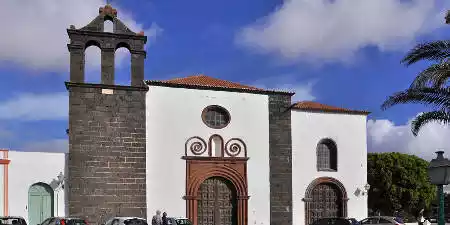
The convent of San Francisco, was built in the 16th century and after some reforms it has opened its doors as a Museum of Sacred Art.
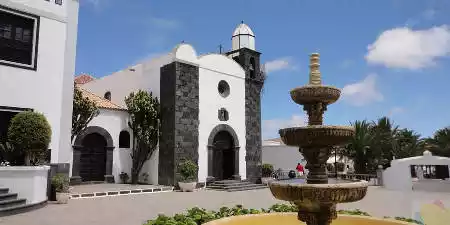
The Church of San Bartolomé is one of the most important religious buildings on the island of Lanzarote.
Built in the 18th century, inside there are several religious images of great artistic value, as well as a beautiful dome decorated with frescoes.

Promoción y turismo en internet