

The municipality of Yaiza, with an area of 211.84 km², is the southernmost and westernmost municipal area of the island of Lanzarote. Surrounded by the Atlantic Ocean, it borders to the north with the municipalities of Tinajo and Tías.
In the area known as the Rubicón, a group of people settled. the first European enclave in the Canary Islands, from where the the conquest of Lancelot. The modest chapel of that place, that of San Marcial de Rubicón, passed to become a cathedral, thus being erected the first diocese of the Archipelago, in 1404. Nothing remains of the town of Rubicón today.
Share with Tinajo the other large part of the Timanfaya National Park, the main natural attraction of the municipality, a unique place in the world and one of the most relevant to the recent volcanism of the archipelago.
In recent years, Yaiza has multiplied its population and this is mainly due to the fact that the town of Playa Blanca has established itself as one of the best tourist areas of Lanzarote, knowing how to combine its tradition A marine area with quality tourist development.
In Playa Blanca and a few meters from the town, you can enjoy the best beaches on the island: Papagayo. so How to enjoy your boat all year round at the Marina Rubicón.
The port of Playa Blanca connects several times a day, by sea, the islands of Lanzarote and Fuerteventura, a half-hour journey.
According to Madoz, in his famous Dictionary, the church of Los Remedios was founded in 1640, although Agustín de la Hoz postpones the date until twenty years later; it was erected in parish in September 1728.
After the administrative reform of 1766, the configuration of the administrative map of Lanzarote began; Next to Teguise, the capital and seat of the Cabildo, there are elections for public jobs in several places, including Yaiza.
After Femés was incorporated into this municipality in 1952, it is necessary to refer to the historical events that occurred in this territory.
In it was the city of Rubicón, which was episcopal seat, the first in the Canary Islands, until its transfer to the island of Gran Canaria. He landed on these lands. Juan de Béthencourt and with him Gadifer de La Salle.
Also here got up the castle called Las Coloradas or Torre del Aguila. and here The town of Femés is located, one of the most remote villages of the islands, since it entered the in history in the fifteenth century. Your parish is consecrated to San Marcial, patron saint of Lanzarote; It was erected as such, according to Millares Torres, by Bishop Verdugo, in July 1818.
It occupies the southern end of the island. To the north it meets Tinajo, through a rectilinear divide, which goes from the vicinity of Caleta de la Ensenada, on the western coast, to the vicinity of the Peña Palomas Mountain. , inside.
Tías appears in the northeast. The boundary continues from that point, following a line that passes through the Guardilama mountain, finally adopting the bed of the Pila ravine, until its mouth on the eastern coast.
The wide coastal space shows a variety of forms. In the western sector there are coastal badlands, corresponding to the eruptions of 1730-36. It is followed by a steep coast, practically to the southwestern end: Punta Pechiguera. The entire southern sector offers an alternation of small cliffs and beaches, which have their best exponent in Playa Blanca and the Papagayo area.
The eastern sector once again presents a cliff that corresponds, to a large extent, to the coastal edge of the Los Ajaches Massif, and which has few beaches.
A wide sample of geological materials appears in the municipal area, belonging to the different moments in the construction of the Island. The oldest belong to the old Los Ajaches massif, in the southeast , and which has its continuation towards the interior, around the municipal capital. More recent in age than the similar one in Famara, in the north of Lanzarote, this massif has been extensively remodeled by erosive activity. In turn, along its perimeter, it is possible to observe the existence of old sea levels, which have been raised above the current sea level. Along with the predominance of basaltic materials, the punctual presence of salic outcrops can be seen.
A series of later eruptions, already classified within the Second Volcanic Cycle, have rejuvenated these old forms. Its emission centers are located both around Los Ajaches and at extreme points in the municipality, in the case of the mountains of Tinasoria (503 meters) to the northeast, or Roja (194 meters) to the southwest.< /p>
In this way, large flat surfaces appear, interrupted by the presence of some volcanic cones, which have closed ancient valleys, in the case of Femés or Fena, form alignments, or constitute islets, in the middle of the Lavas emitted in the 1730-36 eruption: El Volcán. This historical eruption of Timanfaya occupies a wide sector of the northwest, covering extensive surfaces, not only with lava layers, but also with pyroclastic materials (sand or picón). In this case, the subsequent search for fertile soil, under the large mantle of sand that serves as protection, has given rise to the original agricultural landscape of La Geria.
The southern situation and the low altitude of most of the municipality determines a pronounced aridity, to which is added the mildness and uniformity of temperatures. Thus, the vegetation cover is poor, where gorse and bushes predominate, and areas of tabaibal. The numerous palm trees stand out, in relation to the cultivated spaces.
Until recently, the dominant economic activity in the municipality of Yaiza was agriculture and, to a lesser extent, fishing. Currently, tourism is the main source of resources.
The irruption of the tourist phenomenon in Yaiza is late. The first pension to open in the municipality dates back to 1968. A second category building, with only 12 beds. It is the time of the declaration of the Quemada and Papagayo beaches as areas of tourist interest.
Playa Blanca is today the tourist engine of Yaiza, a considerable distance from Puerto Calero and Playa Quemada, which have far fewer beds. Although the hotels are not very numerous in this old seaport, since the offer has been oriented more towards apartments and bungalows.
Currently, the largest tourist contingent is German, followed by the British, and tourists from other origins, such as Italy, the United States and former Eastern European countries and from the Russian Federation. The high season focuses on winter, especially in the months of November to March. The high occupancy rates that are also recorded in summer are mainly due to local tourism and that from other islands, which occupies a good number of non-hotel beds in Playa Blanca. </p >
The pull that tourism and construction have meant for the local economy can be seen in the levels of employment in the municipality. In the eighties Yaiza offered the lowest unemployment rate in Lanzarote, with three percent of the active population.
The magnificent work of the Salinas del Janubio, with its original and complicated structure, is largely due to the ingenuity of Víctor Femández, El Salinero, (Las Breñas, 1844-1920). In charge of the salinar until his death, he was also the author of an extensive collection of couplets. Now that the Berrugo salt mines, near Playa Blanca, have disappeared, El Janubio is practically the only exponent, in the municipality and on the Island, of this hard productive activity, of great ethnographic interest.</p >
As for the festivities of the municipality, the copla sums up the three most outstanding ones: San Marcial esta; in Femés, and Los Remedios in Yaiza; Charity is in La Geria... San Marcial (July 7), with an ancient tradition, has an insular character.
Recognized fame have the wines of La Geria.
The Timanfaya Natural Park hosts a large part of the historical eruption of 1730-36, allowing you to contemplate a great variety of volcanic forms, in a desolate space that is beginning to be colonized by numerous plant and animal species .
Already outside the National Park, but always within the area affected by these eruptions, La Geria Natural Park also brings together a unique agricultural landscape. On the coast, the advance of the lavas made possible the formation of the green Los Clicos lagoon, inside the crater of the El Golfo volcano; o It has given rise to the impressive spectacle of Los Hervideros, a set of caves and bufaderos, where the sea water seems to boil. Nearby, the natural space of Janubio, salt flats that add to their aesthetic and ethnographic value, the natural; above all, for its avifauna and existing invertebrates.
Los Ajaches is an example of an old massif, which preserves interesting botanical endemisms, and some rare Houbara specimens. Added to all this is a magnificent coastline, free of tourist developments, and the existence of outstanding archaeological sites.
The visit to the two towns, Yaiza and Femés, constitutes an interesting attraction, since in both towns the architecture of their buildings and their urban layout stand out for their picturesqueness.
In Yaiza we must visit the parish church of Nuestra Señora de Los Remedios, with three naves, in which a beautiful carving of the titular saint is preserved.
One of the most sumptuous mansions was built by Don Ruperto Vieyra in the middle of the last century, which was the first to have running water on the island. Finally, our steps head towards the small church of San Marcial, in Femés, with its arcades and column shafts adorned with curious collars. The image of the patron saint that we can see is not the first, which disappeared in the fire, but rather a carving from the 18th century, which is highly venerated.
The municipality of Yaiza is made up of 10 towns, each offering its own unique character and charm. These include the main town of Yaiza, as well as Playa Blanca, El Golfo, Femés, Las Breñas, Montaña Roja, Puerto Calero, Uga, La Rubicón, and Las Salinas.
From the popular beaches and resorts of Playa Blanca to the scenic beauty of El Golfo and the traditional village life of Femés, the towns of Yaiza are a perfect blend of Lanzarote’s rich history, natural landscapes, and coastal allure. Visitors can explore volcanic craters, discover hidden beaches, or experience the island’s authentic charm, making Yaiza a must-visit destination on Lanzarote.
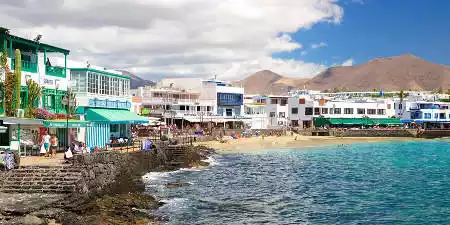
The great growth of Playa Blanca in recent years has consolidated it as an enclave ideal tourist destination in Lanzarote.

Puerto Calero, has one of the most prestigious and modern marinas in Europe.


Las Breñas is a mountain village in the southwest of Lanzarote on the slopes of the Los Ajaches mountain.
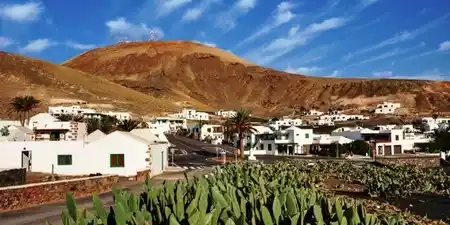

The town of Las Casitas de Femés is made up of a small group of white houses typical of Lanzarote.
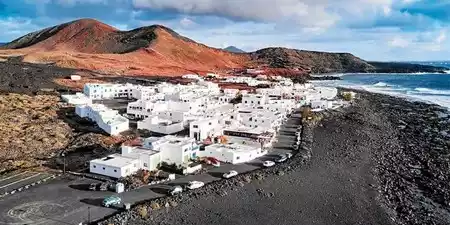

Small town with more than three centuries of history that is born between two mountains in the south of Lanzarote .


Promoción y turismo en internet