

Arrecife, the capital of the island of Lanzarote, is a city full of history and charm, which attracts thousands of tourists every year. With a privileged location in the center of the island, it is surrounded by the crystal clear waters of the Atlantic Ocean, which makes it an ideal destination for those looking to enjoy the sea and the sun in a calm and relaxed environment.
From its beginnings as a modest fishing port to becoming the commercial and financial center of the island, Arrecife has maintained its essence and tradition and has known how to combine them with the comforts and services that today's tourism demands. This city is a place where the past and the present coexist in harmony, offering visitors a unique and enriching experience.
It is a tourist destination that offers a wide variety of activities and entertainment for all tastes. From its golden sandy beaches to its shopping and entertainment areas, there is something for everyone. And we cannot forget its gastronomy, which is a delicious fusion of Canarian and Spanish flavors.
The origin of the city of Arrecife as such dates back to the 15th century, when a small population center began to form around the hermitage of San Ginés, located next to El Reducto beach. At this time, Arrecife was a modest port where the Herrera silo and a few scattered buildings were located.
The official foundation of Arrecife as a city took place in the 16th century, shortly after the arrival of the European conquerors on the island. In 1402, the Normans Jean de Bethencourt and Gadifer de la Salle conquered Lanzarote, and soon after the territory passed into the hands of the Crown of Castile.
In 1477, Diego de Herrera's ships supplied supplies and loaded materials in the port of Arrecife, which marks the beginning of his commercial activity. From then on, the city developed thanks to maritime trade, and various buildings and fortifications was built to protect it from pirate attacks.
In the 16th century, several buildings and fortifications were built to protect the city from pirate attacks, and one of the most prominent buildings from this time is the Castillo de San Gabriel, under the direction of the engineer Leonardo Torriani, which was built in 1574. to defend the entrance to the port of Arrecife.
In the 18th century, the Castillo de San José was erected, which guaranteed the defense of the town and its commerce. At that time, the barilla was the most important export product of Arrecife, which promoted the development of the port and the city. However, when the demand for barilla began to decline, the local economy became focused on the import and export of the cochineal, a parasitic insect of the prickly pear that was used as a reddish dye in the British textile industry.
This cochineal boom coincided with the consolidation of Arrecife as the economic and political center of Lanzarote, surpassing Teguise as the island's capital in 1847. That same year, the transfer of the Military Court was achieved and the island's capital status was achieved.
In the 19th century, fishing became the basis of the city's economic activity, both inshore and on the nearby African coast; This gave rise to an important salting industry and the consequent appearance of salt flats.
In 1852, the Free Ports Decree allowed Canary ports, including Arrecife, to trade in international markets without having to pay the taxes and customs in force in the rest of Spain. This further boosted the economic and commercial development of Arrecife, making it an important port for international trade.
In 1908, the first commercial pier was built and the development of the traffic of the first correíllos allowed it to experience a new stage of prosperity.
During this period the base of its economic activity was fishing, both inshore and on the next African coast; it gave rise to an important salting industry and the consequent appearance of salt mines. The catches not only served local consumption but also supplied the rest of the islands and other African countries.
Tourism in Arrecife began to develop in the 1960s when the island of Lanzarote became a popular tourist destination among European, mainly British, tourists. Since then, the city has experienced significant growth in the tourism sector.
Currently, Arrecife is the commercial and financial center of the island of Lanzarote, an important port of entry for tourists who visit the island, and has a wide range of services and shops. In addition, its location in the center of the island makes it a strategic place for the distribution of goods and services.
The two mentioned castles stand out especially, of San Gabriel and San José.
First, it is accessed by the beautiful Puente de Las Bolas, characteristic of the city; Built on the islet of Quemado, its beautiful image tells us about the heroic defense of the inhabitants against the various attacks suffered. The second, that of San José, is located between the Naos and Los Mármoles docks, on a promontory; Built by order of Carlos III, it has been restored under the direction of César Manrique, becoming the International Museum of Contemporary Art.

This fortress was built between 1776 and 1779 during the reign of the Bourbon monarchy of Carlos III.
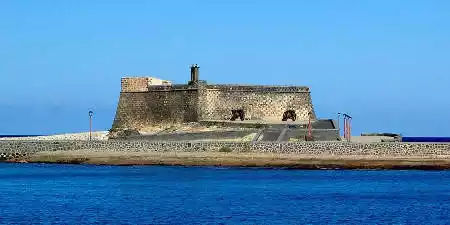
Originally it was a fortress of wood, but it was insufficient to fulfill the defensive tasks
The coastline, despite its deterioration, continues to be practically the only point of natural attraction. Next to the Charco de San Ginés, surrounded by buildings, and fortunately sanitized, it is possible to point out the islets and coastal reefs, which define the coastal landscape of the insular capital.
El Reducto Beach, located in the center of the city, is one of the main tourist attractions in Arrecife. This beach of golden sand and crystalline waters has all the necessary amenities to enjoy a day at the beach.

Blue flag of the European Union, it has a long avenue that borders the sea coast. Its sand is golden and fine and is 400...
The church of San Ginés is a beautiful church located in the heart of the city and is one of the oldest churches on the island.
In addition, Arrecife has a large number of shops, restaurants, and bars, making it an ideal place to explore and enjoy local life.
Arrecife is divided into several neighborhoods, each with its personality and charm.
Arrecife celebrates a large number of festivities throughout the year, many of which have religious roots and are celebrated in honor of the city's patron saints. The most important of these festivities is that of San Ginés, the patron saint of the city, which is celebrated in August. During the San Ginés festivities, the city is filled with music, dances, processions, fireworks, and sporting events, including the popular Arrecife Bay regatta.
Another important festivity in Arrecife is that of the Virgen del Carmen, the patron saint of fishermen, which is celebrated in July. During this festivity, a maritime procession takes place in which the image of the Virgin is carried by boat by the city's fishermen, followed by a large number of decorated boats.
Other major festivities include Carnival, which takes place in February and March and features parades of floats and costumes.
Overall, Arrecife's festivities are a unique opportunity to experience Lanzarote's culture, music, and tradition, and are a showcase of the city's rich history and cultural heritage.
The Canarian carnival, so poor in autochthonous elements that maintain its validity, has an exception here. The Parranda Marinera de Los Buches is a group, made up of a group of players and singers and another group of dancers. These last ones, dressed in a peculiar way and with colored ribbons, have their faces covered and raise large maws or fish guts, with which they strike. The songs refer, mostly, to the world of the sea.
Corpus Christi also has a special meaning, with the production of colored sea salt-based rugs. A sample of the use of a resource, very abundant on the island in relatively recent times, given a large number of existing salt pans, even in the capital itself. The San Ginés festivities, in August, are the oldest on the island and are considered of national tourist interest. The lateen sail waffles constitute an autochthonous sporting manifestation and collect the tradition of the old boats dedicated to fishing. On the other hand, boats are still being made in an artisanal way, by riverside carpenters.

Promoción y turismo en internet