
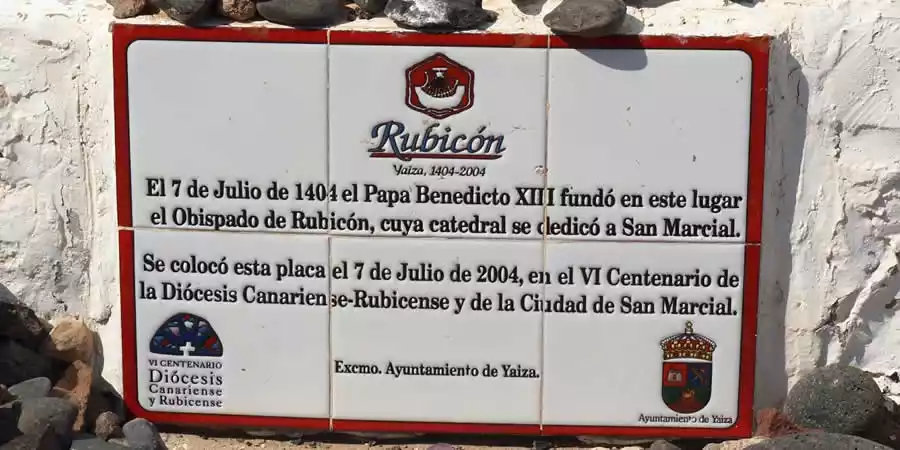
On the southeast coast of Lanzarote, at the foot of the ancient massif of Los Ajaches, in the Papagayo area, lies what has been considered the first European settlement in the Canary Islands: San Marcial del Rubicón. This site is linked to the Franco-Norman conquest of the island, led by Jean de Bethencourt and Gadifer de la Salle, in the early 15th century.
The natural conditions of the location, in the strait that separates Lanzarote from the islands of Lobos and Fuerteventura, provided an ideal anchoring point for ships. Additionally, the availability of water and the possibility of building a fortification made it an ideal spot. These factors led to its designation as the first bishopric of the Canary Islands in 1404, known as the "Obispado Rubicense."
This fledgling settlement featured a tower, a church-cathedral, several wells, houses, a cemetery, and manufacturing areas. However, Teguise would eventually rise to dominate in terms of economic, population, and political influence. The relocation of the cathedral to Gran Canaria in 1485 marked the beginning of the decline of San Marcial, further exacerbated by pirate attacks.
The most notable features of the site are the wells, which were of great importance due to the scarcity of water on the island. These wells, found along the bed of the ravine that ultimately bears their name, remain a key element of the area. While seven wells were originally mentioned, only four are known today, with two believed to be the oldest:
The San Marcial Well: This well, the closest to the beach, has been used and reused over time. It can be accessed by a ramp leading to two chambers, which are covered by a vaulted ceiling.
The Pozo de la Cruz: Located about 40 meters upstream from the San Marcial Well, this well has a chamber that opens to the outside through a curb, with a stepped access. Here, a series of rock carvings can be found, including a triangular figure thought to represent the Phoenician goddess Tanit, as well as two geometric motifs resembling human feet.
The old tower, which may have had a perimeter of 6.80 by 6.80 meters, would have been surrounded by other defensive structures. It sits on a promontory by the beach, on the right bank of the Los Pozos ravine.
On the left bank of the ravine, atop a small hill, lie the remains of the original church-cathedral of San Marcial, which is thought to have measured 13.5 meters in length by 7 meters in width. Archaeological work has not revealed any remains directly linked to this structure, which is only identified by a cross erected around 1862, when the parish priest of Yaiza identified the foundations in this area.

Promoción y turismo en internet