
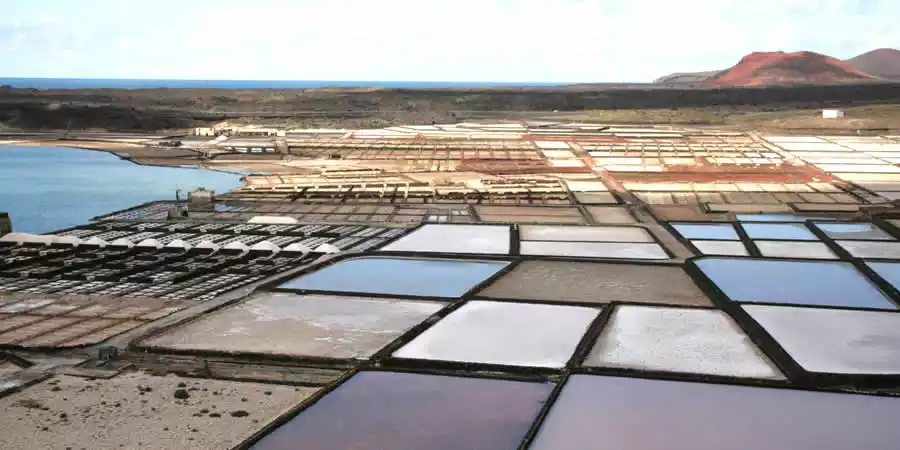
Salinas de Janubio is one of the most iconic landscapes of Lanzarote, known for being the largest salt flats in the Canary Islands. These salt pans were designed with geometric shapes, and the different colors of the salt pans are a result of varying water levels. The landscape offers an incredible opportunity for photography, especially during sunset, when the sun’s rays create a stunning play of colors over the evaporating water pools.
Salinas de Janubio is located south of Lanzarote, within the municipality of Yaiza, and is also home to a black sand beach, though bathing is discouraged due to strong currents. This area is also notable for its popularity as a birdwatching spot, particularly in spring and autumn when migratory birds visit the site. There is a large car park and a viewpoint that offers a beautiful panoramic view of the salt flats.
Historically, Janubio was once a bay that housed the old Port of Janubio, which was destroyed by lava flows from the Timanfaya eruption in the 18th century. After the destruction, a lake formed with a circumference of more than 1,000 meters and varying depths. In 1895, the Lleó and Sardinia families started constructing the salt pans, completing them in 1945. The salt flats spanned 440,000 square meters, producing 10,000 tons of salt annually, although today only 20% of that production remains.
The Salinas de Janubio were declared a Site of Scientific Interest in 1987 and reclassified in 1994. They form part of the Core Zone of the Lanzarote Biosphere Reserve, which was recognized by UNESCO in 1993. The site's outstanding landscape, geological features, ethnographic interest, and unique coastal fauna contribute to its significance.
Declared by: Law 12/1987, June 19, as a Natural Site of National Interest.
Reclassified by: Law 12/1994, December 19, as a Site of Scientific Interest.
Ecological Sensitivity: The entire area is considered an Area of Ecological Sensitivity under Law 11/1990.
Bird Protection: The salt flats are a Special Protection Area for Birds (ZEPA) and are included in the Ramsar Convention on Wetlands of International Importance.
Cultural Interest: The salt flats have been declared an Asset of Cultural Interest, including as a Monument and a Paleontological Zone.
Relationship with other spaces: The site borders the Los Volcanes Natural Park to the north.
Salinas de Janubio hosts an array of migratory and nesting birds. Over 70 species of migratory birds have been cataloged, including plovers, sandpipers, turnstones, and flamingos. The site is recognized by the Spanish Society of Ornithology as one of the most important locations for migratory waders in the Canary Islands. Nesting species include the common black-winged stilt and the Kentish plover, along with other land birds like the marsh landbird, road pipit, and trumpeter bullfinch.
The vascular flora in the area includes 93 species, with 9 endemic species. The vivid red color of the salt pans is due to the presence of Artemia (a red crustacean), along with an algae, Dunaliella salina, and bacteria like H. salinarum and H. halobium. These organisms thrive in the highly saline environment, contributing to the site's unique appearance.
The Salinas de Janubio remain an important landmark on Lanzarote, offering a glimpse into the island's history of salt production, its geological wonders, and its role as a habitat for a wide variety of bird species. Visitors can enjoy the stunning landscape, especially at sunset, while respecting the ecological importance of the site.

Promoción y turismo en internet