
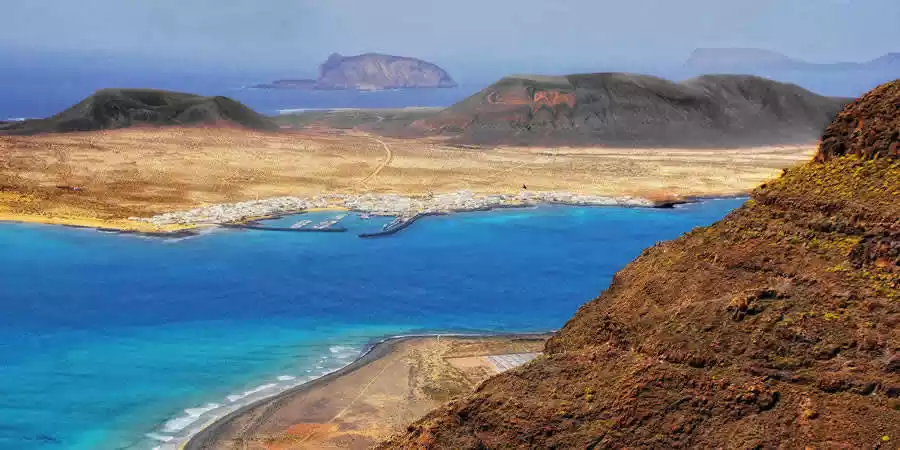
In 1986 the Chinijo Archipelago Natural Park was declared, being the first maritime-terrestrial natural park in Spain. It forms the largest marine reserve in Europe with 9112 hectares. It includes the islets and rocks of the Chinijo Archipelago (La Graciosa, Alegranza, Montaña Clara, Roque del Este and Roque del Oeste or from Hell), as well as the marine environment that surrounds them, the western coastline of the Famara massif and the Lomo Blanco and Costa Blanca plains. In addition, the islet of Montaña Clara, together with Roque del Este and Roque del Oeste or Roque del Inferno, have special protection as an integral reserve.
Its geomorphological importance is very important and we can distinguish two clearly differentiated areas:
To its geological and landscape importance must be added the biological</b >, a place that houses most of the ecosystems present in Lanzarote, with several threatened and protected species -some exclusive to this park-, and nature in a good state of conservation. In addition, the presence at various points of bird egg beds prehistoric people that inhabited the islands, gives it a scientific value additional.
The Natural Park has 120 species of lichens. There are also about 390 taxa of vascular flora, of which about 62 are endemic to the Canary Islands, representing 12% of the total for the entire Canary Islands, and 78.5% of the endemisms present in Lanzarote and its islets. Some stand out, such as: Bupleurum handiense, Caralluma burchardii, Euphorbia balsamifera, etc.
The best represented vegetation is the coastal salt marsh.
This space is of vital importance for the nesting of seabirds, birds of prey and other very rare birds. In addition, it constitutes one of the most important sectors of the Canary Islands for migration, especially for passing species. For this reason, it has been cataloged since 1994 as a Special Protection Area for Birds (ZEPA).
There are numerous seabirds that have their colonies of breeding on the islets. Of these, seven species are nesting, such as the Bald-breasted and Madeiran Storm-petrel, Cory's Shearwater and Little Shearwater. Another group of birds present are the birds of prey, represented by the osprey, Eleanor's falcons, the Egyptian vulture or guirre, etc.
The mammals are scarce, although it should be noted an endemic species, the Canary Shrew (Crocidura canariensis), which is the only native land mammal that breeds in said space. Some specimens have also been located that could be the Clear Edged Bat (Pipistrellus kuhlii), although its existence has not been confirmed. reproduction.
As for the reptiles we find three endemic species of Fuerteventura, Lanzarote and its islets: the Perenquén Majorero or Rugoso (Tarentola angustimentalis), the Atlantic Lizard (Gallotia atlantica) and the Lisneja o Lisa Majorera (Chalcides simonyi).
As for the species of < b>terrestrial invertebrates within the Chinijo Archipelago Natural Park we can find some 14 endemics such as the Cryptella canariensis, a kind of slug.
The marine environment of the islets maintains a unique wealth due to its diversity of habitats and has 228 species of fish. The rocky bottoms with algae meadows and the sandy and sebadal bottoms shelter a great variety of fauna and flora, observing pelagic species such as needles, amberjacks and various tuna species; and demersal species such as groupers, abades, viejas, sea breams, dogfish and captain rosemary, among others.
The waters of the archipelago are equally rich in exotic subtropical species, both animal and plant species, including: the limpet, the star of spiny sea, lobsters, groupers, etc. In flora, the Codium algae stands out.
Some cetaceans can be observed in the waters of the park, especially in migration months, some such as: Balaenoptera acutorostrata, Grampus griseus, Delphinus delphis, etc. .
There is also evidence that there are few specimens of the Mediterranean monk seal in the natural area, a species in critical danger of extinction
It is home to the world's second colony of Cory's shearwaters with more than 10,000 pairs.
The only Atlantic colony of Eleanor's falcon (comes to Alegranza and Montaña Clara from Madagascar.
The only place in Spain for the nesting of the White-breasted Warbler.
You can also see the bulwer petrel, osprey, common storm-petrel, Madeira storm-petrel, guinchos, guirres, owls, etc.

Promoción y turismo en internet