
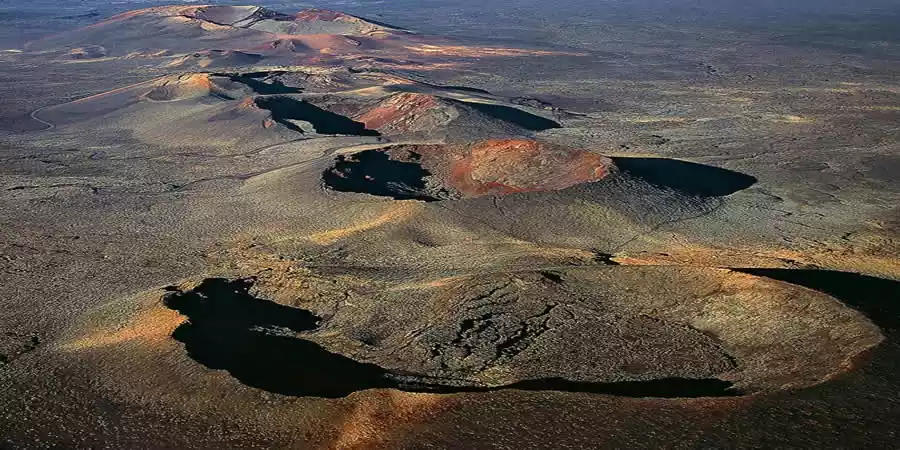
The Natural Monument of Las Montañas del Fuego is part of the Timanfaya National Park, which was declared a National Park in 1974, making it one of the 12 existing National Parks in Spain. It is the only one in the Spanish National Parks Network of geological nature. However, it wasn't until 1994 that this area, located at the heart of the park, was reclassified as a Natural Monument, with a total area of 392.9 hectares.
This monument represents the fourth eruptive phase of the entire Timanfaya complex, which was formed by eruptions that took place between 1730 and 1736 and in 1824. It features a spectacular landscape of impassable lava flows of the "aa" (badlands) and "Pahoehoe" (cordate) types, interspersed with several volcanic cones. Among the most significant are the Montaña de Fuego, Timanfaya Mountain, and the Islote de Hilario, which is home to the El Diablo restaurant.
Even today, the area still exhibits some volcanic activity, evidenced by the heat emanations from the earth. Visitors can observe these phenomena at Islote de Hilario, where the ground temperature reaches 400ºC at a depth of 2 meters and 600ºC at 10 meters.
Human interference in this area has been minimal, and, together with the island's unique climate, this has allowed the original volcanic landscape to remain nearly intact. This makes it an exceptional natural research laboratory for studying colonization processes of both fauna and flora.
The combination of its unique volcanic features, geological and geomorphological significance, stunning beauty, and well-preserved state has made the Las Montañas del Fuego Natural Monument a symbol of Lanzarote.
The area is part of the Timanfaya National Park, created by Decree 2615/1974, dated August 9, 1974.
It was reclassified as a Natural Monument by Law 12/1994 of December 19, concerning the Natural Spaces of the Canary Islands.
This area is considered ecologically sensitive, as indicated by Law 11/1990 (July 13), on ecological impact prevention.
Location: Inside the Timanfaya National Park.
Municipalities: Yaiza and Tinajo.
Area: 392.9 hectares.
Population: None.
This region remains one of the most important geological and scenic areas of Lanzarote, drawing visitors and researchers from all over the world.

Promoción y turismo en internet