
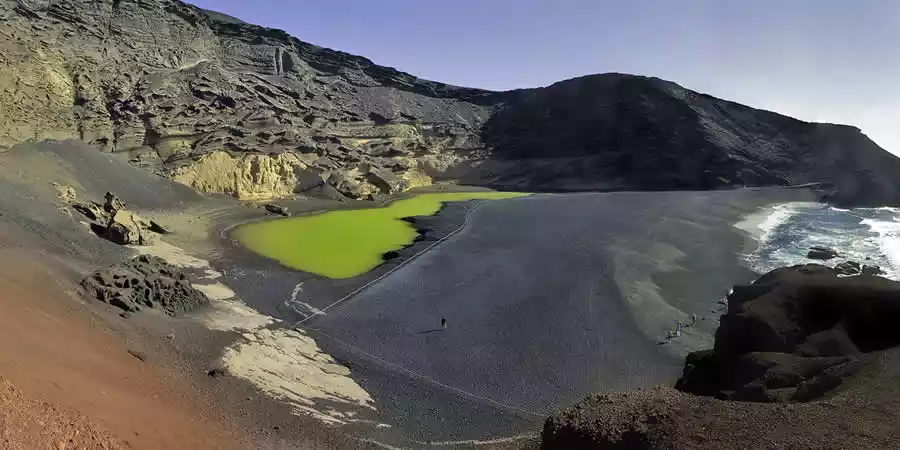
Outside protection zone limits. n marine of the Timanfaya National Park, to the south, is the Gulf, a curious coastal phenomenon. It is an old volcanic building that has been surrounded by historical lava flows from the eruption of the Timanfaya National Park (1730-1736).
Its location on the west coast of Lanzarote has determined that it has been affected by the erosive action of the sea, which has largely dismantled it, sectioning it in half, and even leaving a rock isolated, separated from the rest of the building.
At the bottom of the split cone and at the foot of the cliff a small and striking lagoon has formed whose waters filter from the sea. The lagoon several meters deep, has an intense emerald green color that stands out between the black lava and the clean blue of the ocean. This place is known as Charco de los Clicos you can find the strange olivines, semi-precious stones with which local artisans design original jewelry.
El Golfo is a place very visited by tourists. Next to it, to the north is The small and attractive town of El Golfo, famous throughout the island for the excellent fresh fish that is served there. you can taste.
In front of the Clicos lagoon there is a beautiful black sand beach, about 300 m long. is finished off on the south side by a yellow rock; This one has a vertical platform that goes into the water and is ideal for sunbathing.
El Golfo beach and its green lake may seem familiar to moviegoers. And it is that this magnetic landscape has called the attention of several filmmakers, among them Pedro Almodóvar, who moved here He joined his team in 2008 to record a romantic sequence, starring Penélope Cruz and Lluís Homar, for his drama Los abrazos rotos (2009). “The volcanic origin of Lanzarote turned the walk into an inner, exciting and emotional journey,” the director from La Mancha about his first impressions of the island. “For me it was not a landscape, but a state of mind, a character”.
Classic film lovers will have Raquel Welsch emerging from the green waters of the lake in a “prehistoric” in the British film A Million Years Ago (1966), which was set in the Palaeolithic. Other films have also been shot in this area, such as the spaghetti western By the hardest path (1975), the science-fiction Enemigo mio (1985) or La iguana (1988), based on the novel by Alberto Vázquez-Figueroa.

Promoción y turismo en internet