
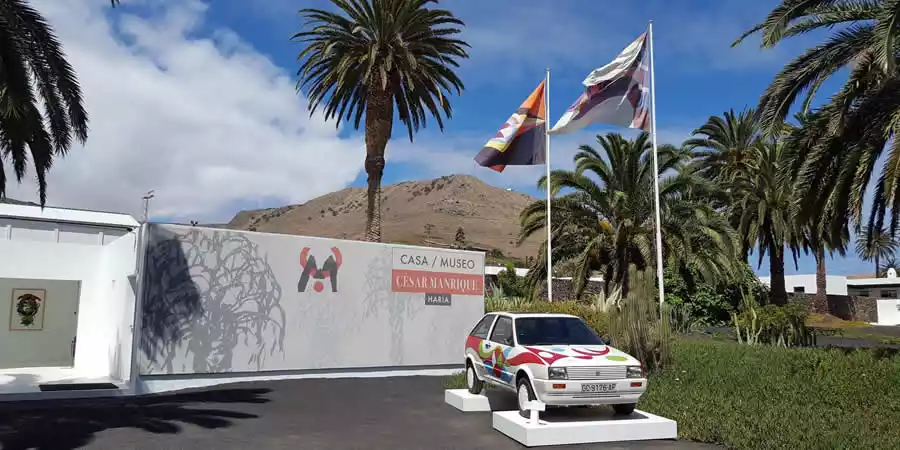
In 1988, César Manrique moved He moved his residence in Taro de Tahíche, the current headquarters of the foundation that bears his name, to Haría, seeking tranquility and contact with Nature in this town in the north of Lanzarote.
It was installed. in a house built on some ruins belonging to a popular house, located on an estate of 11,261 square meters, which the artist refurbished. and remodeled following guidelines of the traditional architecture of the island. took advantage of some walls and materials, but faithful to its hybrid behaviors, it incorporated also some modern episode, such as the bathroom, which responds to his original conception of this functional space, already practiced in Taro de Tahíche.
The house, with a square floor plan and surrounded by a large orchard with palm trees, originally consisted of two interior patios, a balcony, three bedrooms, two bathrooms, two small living rooms, a kitchen and a living room with a stone fireplace. . Manrique profusely uses stone and wood as reference materials.
It is an intimate, cozy and conventional house, in the middle of an old palm grove, the residence of Haría bases its personality on good taste, allusions to traditional architecture and peaceful interaction with the family. It blends in with the historical and natural environment, renouncing the spectacular. The artist recycles materials and integrates numerous decontextualized objects, which are shown with a purely aesthetic value.
Currently the house is home to the House Museum “a tribute to traditional architecture, reconsidered from a modern perspective in which aesthetics and comfort prevail, in addition to integration in nature”, all constant characteristics of the work of César Manrique. It is “an extension of the artist's way of living and of his creative personality. there he is present his personal universe, which, fortunately, remains intact and reunited”, pointed out those responsible for the FCM.
His tour allows the visitor to contemplate the rooms of the residence and the workshop in which the painter worked during his lifetime. and it happened the final years of his life.
Located in a privileged palm grove, his last house is intimate and familiar. Through two courtyards, you can access a surprising world of personal belongings, utensils, found objects and handcrafted pieces that Manrique endowed with of aesthetic function. All in a space characterized by the nobility of the materials and the features of good taste, in a house that brings together the best of the traditional Lanzarote house. The exuberant exterior and interior vegetation contributes to providing serene and welcoming environments.
In the workshop, isolated from the house, the original setting where he painted daily is shown, surrounded by pigments, tables with drawings, easels and unfinished paintings, preserved as the artist left them. to his death.
The visitor will be able to Enjoy a unique experience in a quiet natural environment such as the Haría Valley. A truly unique world that allows you to get closer to the most human side of the great creator born in Lanzarote.

Promoción y turismo en internet